
- English
- Español
- Português
- русский
- Français
- 日本語
- Deutsch
- tiếng Việt
- Italiano
- Nederlands
- ภาษาไทย
- Polski
- 한국어
- Svenska
- magyar
- Malay
- বাংলা ভাষার
- Dansk
- Suomi
- हिन्दी
- Pilipino
- Türkçe
- Gaeilge
- العربية
- Indonesia
- Norsk
- تمل
- český
- ελληνικά
- український
- Javanese
- فارسی
- தமிழ்
- తెలుగు
- नेपाली
- Burmese
- български
- ລາວ
- Latine
- Қазақша
- Euskal
- Azərbaycan
- Slovenský jazyk
- Македонски
- Lietuvos
- Eesti Keel
- Română
- Slovenski
- मराठी
- Srpski језик
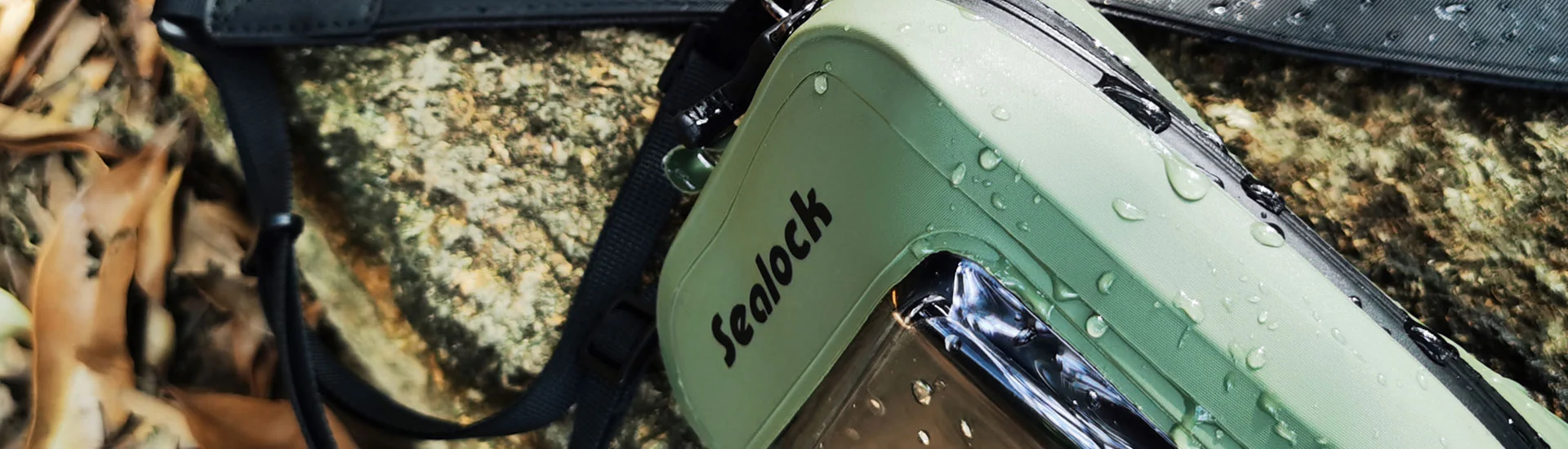
OEM Motorcycle Waterproof Bags for Global Distributors
Sealock manufactures OEM motorcycle waterproof bags for global distributors, importers, and dealer networks from factories in China and Vietnam. A distributor already carries thousands of SKUs from brands it does not own, at margins those brands set. An own-brand luggage line changes that equation — but only if it covers the mounting positions riders actually use, carries stated load ratings, and stays consistent enough to replenish for years. This is how a distributor programme is specified and run.
1. Company and Production Base
Sealock (YiFuLong Outdoor Gear Co., Ltd.) has built welded waterproof bags for over 20 years, producing for international outdoor and motorcycle brands including Benelli, Helly Hansen, OSPREY, and CHUMS.
- Established: 2003
- Facilities: Dongguan, China | Ho Chi Minh City, Vietnam — either origin available on any model
- Certifications: ISO 9001, BSCI, SMETA, HIGG, GRS, SCAN
- Terms: MOQ 300 pcs per model, samples 7–15 days, bulk 30–45 days, FOB Guangdong, T/T 30% deposit and 70% balance
- Capacity: up to 30,000 pcs/month on the roll-top luggage line; 15,000 pcs/month on tail bag lines
2. Why Distributors Build Own-Brand Luggage
Three commercial pressures push distributors toward OEM in this category. Price transparency has compressed the gap on identical branded SKUs across regions, so reselling what everyone else lists leaves margin exposed to whoever discounts first — an own-brand product cannot be price-matched line for line. Channel exclusivity matters more each year, with suppliers and distributors co-developing branded products specifically to secure it. And on an own-brand line the distributor holds both the manufacturing and the distribution margin rather than one.
Motorcycle soft luggage suits a first own-brand move. There are no electronics, no homologation burden, no sizing grid, and the product does not date the way apparel does, so stock carries forward and replenishment stays predictable.
3. Build the Range Around the Local Bike Parc
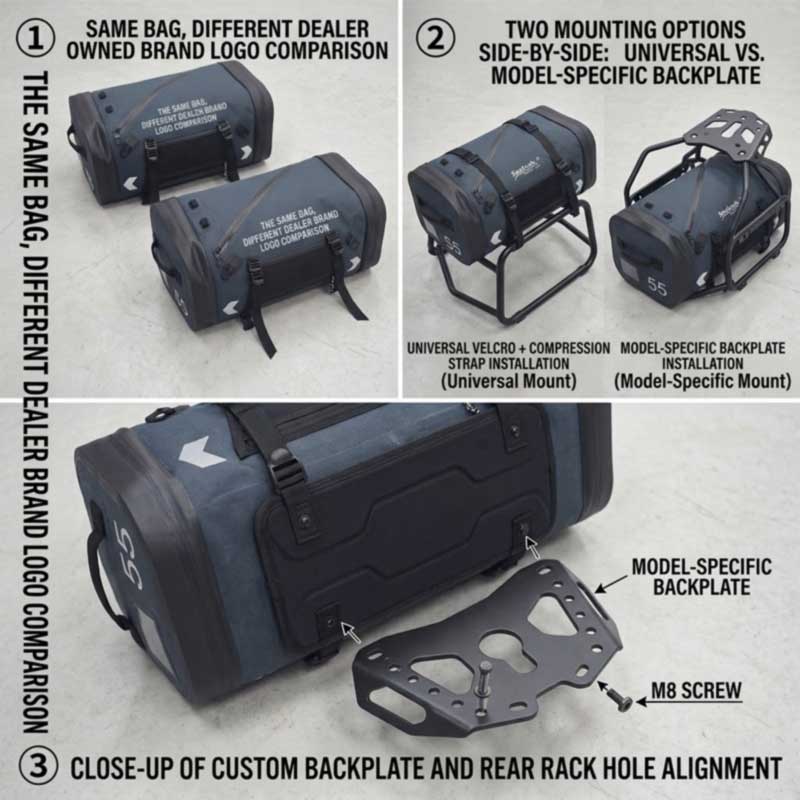
The most valuable input a distributor brings is knowledge the factory does not have: which motorcycles actually sell in its market. Two fitment architectures are available and most distributors use both.
Universal-fit luggage mounts by hook-and-loop panels and adjustable compression or quick-release straps, fitting most machines with a rear seat or luggage rack — adventure, touring, dual-sport, enduro, street, and cruiser. It maximises catalogue coverage from few SKUs and cuts fitment support enquiries. Bike-specific fitment, with mounting hardware or backing plates cut to the rack pattern of the models that dominate a market, commands a higher price and reduces fit-related returns. Custom moulded nylon or CNC-aluminium backing plates can be developed to an existing rack pattern, so a distributor can run bike-specific fitment on its top-selling machines and universal systems across the rest of the range.
4. Catalogue Architecture: Cover Positions, Not Sizes
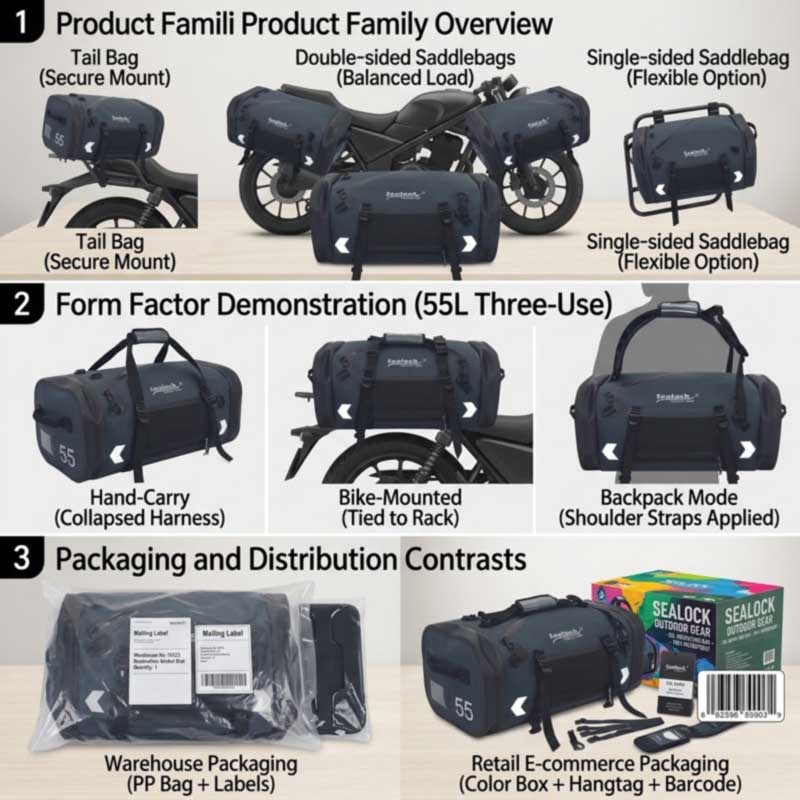
Riders build systems rather than buy single bags, so a catalogue sells better when it covers mounting positions. The range supports four:
| Position | Role in the catalogue | Models |
|---|---|---|
| Tail / rear-rack bag | The volume seller — mounts to pillion seat or rack without side racks | SL-C807 45L, SL-C619 35/50L, SL-C629, SL-C624-A |
| Paired saddlebags | Bulk touring capacity, balanced left and right, 50 kg carrying capacity | 80L (40L × 2), 60L |
| Single-side saddle bag | Commuter and lighter-use price point | SL-C700 40L |
| Convertible premium bag | Higher ticket, cross-sells to riders who also travel and hike | SL-E984 55L 3-way |
Four positions under one logo and colourway generate more attachment per customer than four capacities of the same bag, and they ship in a single production run.
5. Two Price Tiers, Built In
The range splits naturally into an opening tier and a premium tier, which lets a distributor serve both ends without discounting against itself:
- Opening tier — welded 500D PVC tarpaulin with roll-top closure, IPX6. Tough against road spray, grit, and UV, holds a structured shape when strapped down, wipes clean of road film, and welds cleanly at volume. This is where the tail bags and saddlebags sit, and where most catalogue volume comes from.
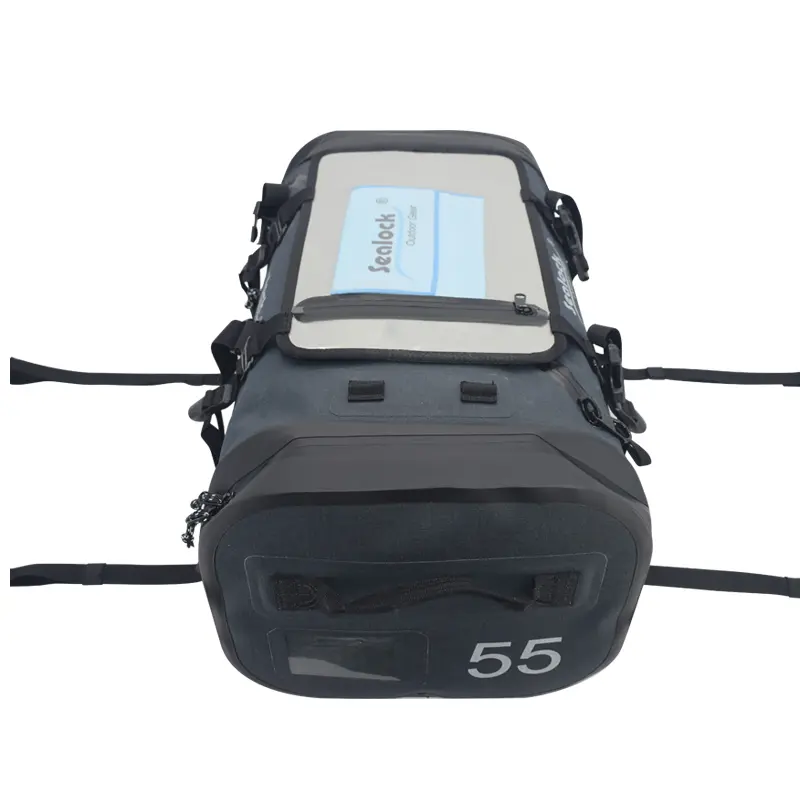
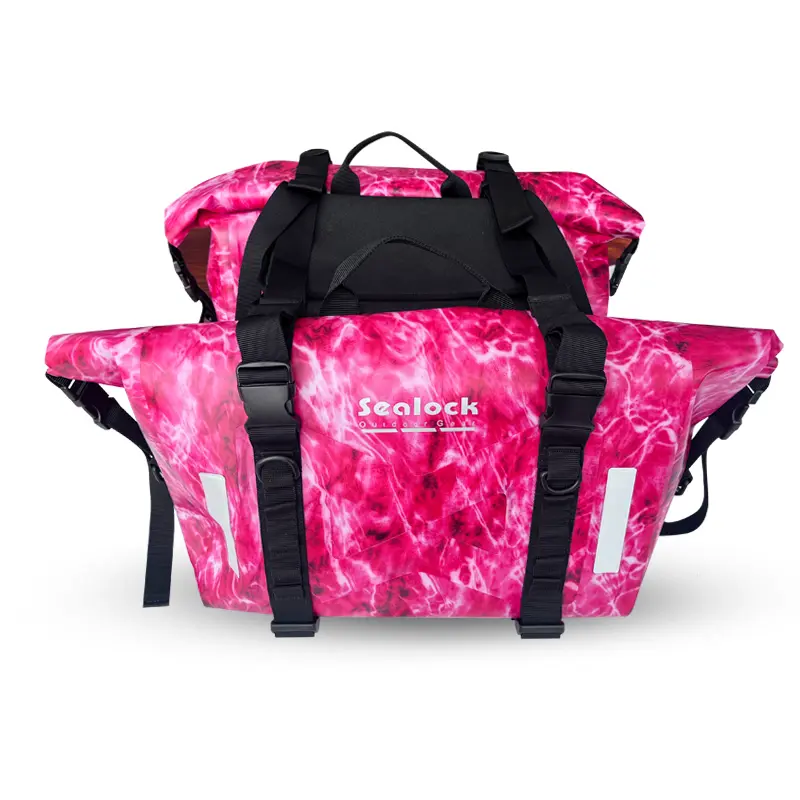
- Premium tier — welded TPU with an airtight zipper, IPX7. The SL-E984 55L uses ripstop TPU laminate (420D on grey, 501D on navy) with an airtight waterproof zipper rated for rain, highway spray, and brief immersion, at 1.27 kg. It converts three ways — strapped to the bike, worn as a backpack with a removable padded harness board, or hand-carried — with four quick-release straps, a shoulder strap, a sealed TPU phone pouch with clear window, reflective panels and piping, a number-plate patch panel, side bungee cords, compression straps, and D-rings, all removable when not needed.
One point to raise early on the premium tier: the SL-E984's appearance is protected by a registered design patent. For OEM partners, distinct original designs are developed rather than copies of protected artwork — which also means a distributor commissioning its own silhouette gets something it can defend rather than a shape already in the market.
6. Load Ratings Belong in the Catalogue Copy
Two figures are worth publishing because competitors rarely do. The paired saddlebags carry a stated 50 kg capacity, and the SL-C807 tail bag is rated at 8–12 kg — real numbers a dealer can quote instead of guessing. Separately, a motorcycle's published rear rack rating is a different figure describing what the rack may carry, not what the bike can carry, and soft luggage transferring its load to the seat rather than the rack is not bound by it. Explaining that distinction in customer-facing material prevents both over-loading and unnecessary lost sales.
On paired panniers, balance is also a specification issue: an 80L system is 40L per side, and left and right loads should stay within a couple of kilograms of each other or the bike becomes unsettled in ruts. The two bags are independently detachable and can be used separately, which is worth stating on the listing.
7. Regional Compliance and Tariff Routing
Product sold into the EU must meet applicable CE requirements, and other regions apply their own frameworks — confirm this at specification stage, since it can affect materials and documentation rather than just paperwork. Expectations differ regionally too: reflective coverage, colourway preference, capacity norms, and price positioning vary between European touring markets, Southeast Asian commuter markets, and Latin American or Middle Eastern markets.
Tariff activity on imported motorcycle components has materially changed sourcing strategy across the sector, with duty movements large enough to erase a thin distribution margin. Origin flexibility is the practical hedge: any model in the range can be produced in Dongguan, China or Ho Chi Minh City, Vietnam, so a distributor can route country of origin to suit its duty position. Landed cost — FOB plus freight, duty, clearance, and inspection — should be modelled before a retail price is set, as covered in the bulk purchasing guide for importers.
8. Packaging and Logistics
Most distributors sell through a dealer network and online at once, and packaging is specified per channel within the same production run: PP or PE bag with export carton and shipping marks for warehouse and dealer distribution, or hangtags, care labels, barcode labels, colour boxes, and OEM carton printing for counter display and e-commerce fulfilment. Standard packing runs one piece per PP bag with 20 pieces per carton on the tail bag lines and 20–30 per carton on saddlebags; the 80L saddlebag set ships at 52 × 42 × 25 cm and about 13.8 kg gross per set. Shipment is from Shenzhen. Confirm carton quantity, dimensions, and gross weight at quotation, because cubic volume drives sea freight cost more than weight does. Private label scope is set out in the guide to private label programmes for outdoor brands.
9. Lead Times Scale With Order Size
Production lead time on this category moves with quantity, and a distributor planning a seasonal launch should schedule against the real figures rather than a single number. On the tail bag lines, orders up to 500 pieces typically run around 35 days, 501–1,000 around 40 days, 1,001–2,000 around 45 days, with larger volumes quoted individually; the black tail bag line runs closer to 30 days at up to 500 pieces. Samples run 7–15 days depending on model, and the roll-top luggage line carries capacity up to 30,000 pieces per month for larger programmes.
10. Replenishment Consistency Is the Real Test
A distributor does not buy once. The programme only works if the fifth container matches the first, because a dealer network and an online listing cannot absorb colour drift, a substituted zipper, or changed fabric between shipments. Consistency is held by a signed gold sample kept by both sides, a repeat-production record covering material names, Pantone codes, logo artwork and placement, hardware finish, packing method, and carton spec, plus colour-fastness and colour-difference testing against the approved standard on every batch. Confirm before the first order whether fabric lot and hardware can be reserved or matched for repeats — it is screenable in advance rather than discovered at reorder.
11. Motorcycle Range for Distribution
Models organized by type rather than priority:
| Image | Model | Capacity | Material | Closure / mounting | Product Page |
|---|---|---|---|---|---|
|
SL-E984 | 55L | 420D / 501D ripstop TPU | Airtight zipper · IPX7 · strap / backpack / carry | View |
|
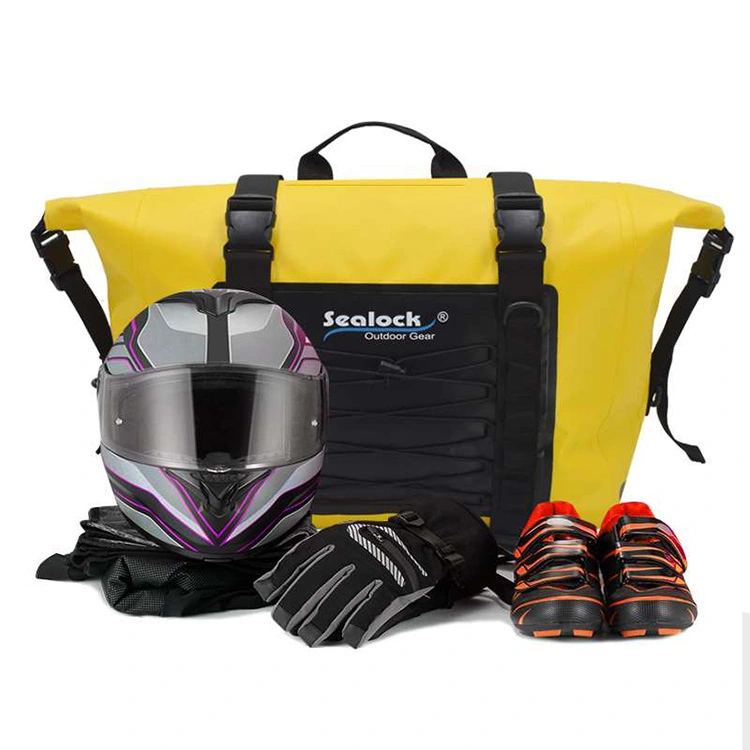
SL-C807 | 45L | 500D PVC / 420D TPU | Roll-top · IPX6 · hook-and-loop + compression straps · 8–12 kg rated | View |

|
SL-C619 | 35 / 50L | 500D PVC tarpaulin | Roll-top · IPX6 · rear rack mount · reflective print | View |

|
SL-C629 | 40 / 60 / 90L | 500D PVC tarpaulin | Backseat / tail rack · 56 × 32 × 50 cm | View |

|
SL-C624-A | 45 / 60L | PVC tarpaulin | Backseat mount · five stock colours | View |
|
80L Saddlebags | 80L (40L × 2) | Welded PVC | Hook-and-loop + two adjustable straps · 50 kg · dual-side reflective | View |

|
60L Saddlebags | 60L | Welded PVC | Detachable both sides · 50 kg · dual-side reflective | View |

|
SL-C700 | 40L | 500D PVC tarpaulin | Single side · MOQ 500 pcs | View |
Full categories sit under waterproof bags, duffels, and dry bags. The engineering requirements behind motorcycle luggage are set out in the guide for adventure brands, and capacity planning for the highest-turnover rear-mounted size in the 40L tail bag guide.
12. OEM Scope
Beyond logo and colour, a distributor programme can specify capacity and proportions, mounting system including backing plates cut to a named rack pattern, closure type from roll-top to airtight zipper, fabric and denier, reflective placement and coverage, carry-module layout, lash points and compression strap arrangement, matte or gloss finish, rated load, phone pouch and accessory configuration, and packaging for both channels. Ground-up development from a sketch, sample, or target spec is supported, with tooling and lead time scheduled against a launch date.
13. Quality Control
Every batch runs IQC on incoming tarpaulin, hardware, and reflective materials; IPQC on welds and mounting-point construction in process, including peel tests on sample welds at run start; and OQC with AQL sampling, batch immersion testing, and signed gold-sample comparison. Load cycling over 1,500 cycles targets mounting straps, D-rings, and handles — what vibration attacks on a motorcycle — alongside tensile and bonding strength, salt spray, friction resistance, colour fastness, and colour difference. The full customer inspection procedure — unboxing, vacuum extraction, a 24-hour static rest, and air-leak determination — can be witnessed end to end, with SGS or QIMA inspection available. Standards are set out in the quality control standards for waterproof production.
14. FAQ
Q: Why move to own-brand when we already distribute established luggage brands?
A: Price transparency has compressed margins on identical branded SKUs across regions, and an own-brand product cannot be price-matched line for line. It also captures both manufacturing and distribution margin and gives channel exclusivity rather than a catalogue everyone shares.
Q: What should a first own-brand range contain?
A: Cover the mounting positions rather than four capacities of one bag — a rear-rack tail bag, a paired saddlebag set, a single-side bag, and a premium convertible model. They cross-sell rather than compete, and ship in one production run.
Q: What load can we advertise?
A: Publish the real figures: 50 kg carrying capacity on the paired saddlebags and 8–12 kg on the 45L tail bag. Explain separately that a motorcycle's rack rating is a different number describing what the rack may carry, and that soft luggage loading onto the seat is not bound by it.
Q: Can we commission our own design rather than rebadge an existing one?
A: Yes, and on the premium tier it is the correct route — the 55L three-way model's appearance is protected by a registered design patent, so OEM partners receive distinct original development rather than a copy. That also gives a distributor a silhouette it can defend in its own market.
Q: How do we protect margin against tariff changes?
A: Route origin. Any model can be produced in China or Vietnam, so country of origin can follow your duty position. Model landed cost before setting a retail price rather than after the container lands.
Q: How far ahead should we order for a seasonal launch?
A: Plan against quantity-scaled lead times — roughly 35 days up to 500 pieces, 40 days to 1,000, and 45 days to 2,000 on the tail bag lines, plus sampling and sea freight. Larger programmes are quoted individually and the roll-top line carries capacity to 30,000 pieces per month.
Request a Distributor Proposal
For own-brand development, fitment engineering for your market, packaging options, or an origin recommendation for your tariff position, submit an inquiry. Sealock responds to procurement enquiries within 24 hours.